



Local SEO
The person searching "plumber near me" is ready to call someone. The question is whether they find you.
Local SEO is what determines whether your business shows up when someone nearby searches for the thing you sell or the service you provide. Not in a week. Not after they have browsed five comparison sites. Right now, on their phone, while they are standing in Wolverton or sitting in a car park in Stony Stratford.
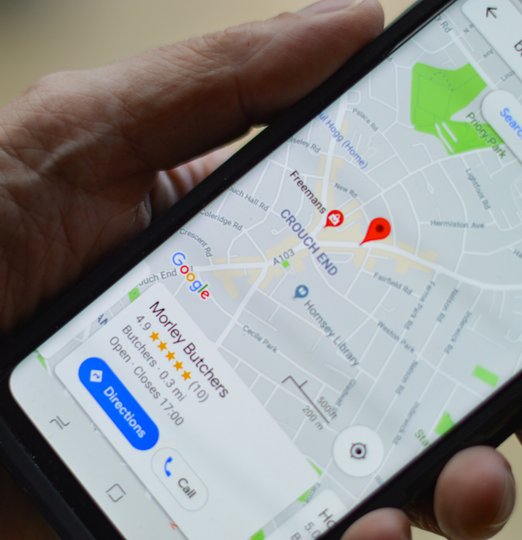
Google serves local results two ways. There is the map pack (the three businesses with the map at the top of the results page) and the standard organic listings underneath. Both are driven by how well Google understands three things about your business: what you do, where you are, and whether people trust you. Local SEO is the work that makes all three of those signals as clear as possible.
This is not the same as having a website. A site can look great, load fast, and still be invisible in local search because nobody told Google where you operate, what areas you cover, or that your business actually exists at all. That gap between "having a website" and "being found locally" is exactly what local SEO fills.
What local SEO actually involves
There is a lot of noise around this topic, so here is what I focus on and why each part matters.
Google Business Profile
Your Google Business Profile (the listing that appears in the map pack and on Google Maps) is the single most important piece of local SEO. It needs the correct business name, address, phone number, categories, opening hours, service areas, and photos. It also needs to stay active, which means regular updates, responding to reviews, and keeping the information consistent with what appears on your website and across the web.
I set up and optimise your profile as part of the work. If you already have one, I audit it for accuracy and completeness. If you do not have one yet, I create it and verify it.
Location pages
If you serve more than one area, a single homepage is not enough. Google ranks individual pages, not entire websites. So a business that serves multiple towns needs a page for each of those areas with unique, locally relevant content on every one. A locksmith covering Bletchley, Newport Pagnell, and Woburn Sands should have a dedicated page for each, not one generic "areas we cover" list.
The Growth plan includes up to 15 pages specifically so there is room for these location pages alongside your core service pages. Each location page is written individually. No copied content with the town name swapped in.
Citations and directory listings
Citations are mentions of your business name, address, and phone number on other websites (directories, industry listings, local business sites). Google uses these as confirmation that your business is real and located where you say it is. The key is accuracy: every listing needs to match exactly. Old addresses, wrong phone numbers, or inconsistent business names weaken the signal instead of strengthening it.
I audit your existing citations, clean up anything that is wrong, and submit your business to the directories that actually matter for your industry and location.
Reviews
Google reviews are both a ranking factor and a trust signal. Businesses with more genuine reviews (and higher ratings) tend to rank higher in the map pack. I cannot write reviews for you, but I can help you set up a system that makes it easy for happy customers to leave one. A direct link to your Google review page, a follow-up email after a job, a QR code on a business card. Small things that build up over time.
On-page signals
Every page on your site sends signals to Google about what your business does and where. Title tags, meta descriptions, heading structure, body content, image alt text, and internal links all play a role. The on-page SEO work makes sure those signals are clear, consistent, and aligned with the terms people actually search for. This ties directly into the keyword research that underpins the whole strategy.
How this fits into what I offer
Most SEO agencies sell local SEO as a standalone monthly retainer, typically £300 to £1,000 a month, bolted onto whatever website you already have. The problem is that if the website itself is slow, poorly structured, or built on a bloated platform, the SEO work is fighting uphill from day one. You end up paying one company to build the site and another to fix the problems the site creates.
I do both. The Growth plan at £380 a month includes the website build (hand-coded, fast, built to meet technical SEO standards from the start) and the ongoing local SEO work: Google Business Profile optimisation, keyword research, competitor analysis, location pages, and monthly reporting. The site and the SEO are built as one thing, not two separate services stitched together.
This is the plan that actually builds rankings. The Business plan at £150 a month builds a site that converts visitors into enquiries, but it is not designed to generate search traffic on its own. It might pick up a couple of basic terms over time, but ranking for competitive local search phrases takes ongoing work and content. That is what the Growth plan adds.
What "ranking locally" looks like month to month
Local SEO is not a one-off project. It is ongoing work that compounds over time. Here is roughly how it plays out.
In the first month, the foundations go in. Google Business Profile is set up or overhauled. The website is built (or rebuilt, if you are coming from a redesign). Initial keyword targets are identified. On-page SEO is applied across every page. The site is submitted to Google Search Console and key directories.
Over months two and three, location pages start going live. Citations are submitted and cleaned up. Content is refined based on early data from Search Console. Google begins to index and rank the new pages, though positions will still be moving around.
From month four onward, the work shifts to monitoring, adjusting, and building on what is already working. New keywords get targeted as opportunities appear. Reviews accumulate. Location pages mature in the index. Rankings stabilise and, in most cases, continue to climb as the site builds authority.
There are no guarantees with SEO. I do not promise page one, and you should be cautious of anyone who does. What I can promise is that the work is done properly, reported on clearly, and focused on the search terms that will actually bring in business.
Local SEO is worth the most to businesses that depend on their area
A plumber who works within a 15-mile radius. A cleaning company covering local postcodes. A solicitor with a high street office. An electrician who gets most of their work through word of mouth but wants to supplement it with online enquiries. These are the businesses where local SEO has the highest return, because the people searching are actively looking to hire someone nearby.
If your business operates nationally or sells products online, local SEO is less relevant (though e-commerce SEO might be). But if your customers are local and they are searching for what you do on Google, this is how you get in front of them.
Ready for a Better Website That Ranks?
Let's Build itMonday to Sunday: 24 hours
Call, Text or WhatsApp us anytime
for a free consultation call.